
TOWARDS THE FUTURE
DECEMBER 25, 1947
MR JINNAH’S LAST BIRTHDAY
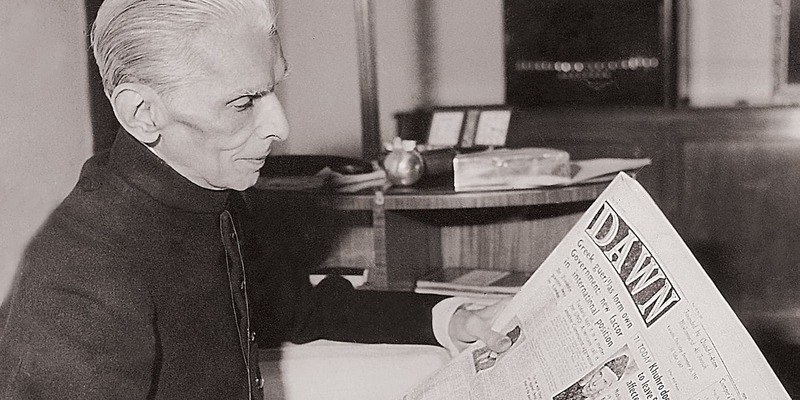
In the photograph above, courtesy Dawn/White Star Archives, Quaid-i-Azam Mohammad Ali Jinnah reads Dawn on his 71st birthday.
Mr Jinnah’s first birthday in Pakistan on December 25, 1947, is tragically his last one too. The morning starts when a smal delegation of journalists from Dawn Karachi, led by the editor, Altaf Husain, calls on him to express their best wishes. They find him reading the morning’s edition of Dawn.
As he reminisces about the heady days when Dawn is founded in Delhi, he expresses his satisfaction that the title and the ethos of Dawn are preserved and are prospering in Karachi.
And then something unusual happens. Never in his career has Mr Jinnah ever endorsed what today we would consider to be a ‘product’ or ‘brand’. And yet, at the behest of his colleagues, he picks up the copy of Dawn at his side and agrees to be photographed reading it.
The newspaper item on the front page congratulates Mr Jinnah on his 71st birthday, and there is a trace of a whimsical smile on his lips. He has come a long way from when he founded Dawn Weekly in October 1941. Those were days of hope; six years later, Dawn, published by Pakistan Herald Limited Karachi, is a living reality.
Later, Mr Jinnah attends the official reception at Governor-General House. He leaves early to attend a private birthday party given by his colleague, Sir Ghulam Hussain Hidayatullah.
As the Commander of the Sind Women’s National Guard, Pasha Haroon sings a birthday poem written for him by a poet in Lahore; he is visibly embarrassed and keeps knotting the napkin placed before him on the table. The words of the poem are: Millat kay liye aaj ghaneemat hai tera dumm, Aey Quaid-i-Azam/Sheeraza-e-Millat ko kiya tu ne faraham, aey Quaid-i-Azam. (Your breath alone is sufficient for the nation, oh Quaid-i-Azam/ You alone have been the binding force for the nation, oh Quaid-i-Azam.)
Nine months later, on September 11, 1948, Mr Jinnah surrenders to a prolonged bout of tuberculosis, an illness that afflicts him over the last decade of his life, and is kept a secret. The next day, Dawn pronounces “The Quaid-i-Azam is dead. Long live Pakistan!”
On the same day, Indian troops under the guise of police action, march into the Princely State of Hyderabad, and annex the state to India.
THE QUAID-I-AZAM 1947
THE LEGACY ENDURESQuaid-i-Azam Mohammad Ali Jinnah is seated with the Pakistan flag draped behind him in Karachi in December 1947. — Excerpted with permission from Witness to Life and Freedom, Roli Books, Delhi
This photo, which appears on the cover of the January 5, 1948 edition of Life magazine, is part of a series taken by Margaret Bourke-White for the magazine.
Today, as Pakistanis celebrate the 70th year of their country’s existence, it is worthwhile to ponder on the legacy of Mr Jinnah, the man who founded what in 1947 is the world’s largest Muslim state.
An uncompromising adherence to the rule of law, freedom of speech and conscience, social justice and equality for all citizens, are the essence of his legacy; a legacy he wants the nation of Pakistan to uphold in the future. Although governance and law-making are the sole prerogative of the people’s elected representatives, as long ago as 1919, he tells the Imperial Legislative Council that “no man should lose his liberty or be deprived of his liberty without a judicial trial in accordance with the accepted rules of evidence and procedure.”
Although Mr Jinnah repeatedly avers that Islam has taught us “equality, justice and fair play”, he makes it clear that Pakistan will not be a theocratic state.
On August 11, 1947, in a historic reiteration of his political creed, he tells the Constituent Assembly: “You are free to go to your temples, you are free to go to your mosques or any other place of worship in this state of Pakistan. You may belong to any religion or caste or creed – that has nothing to do with the business of the state.”
Speaking on the topic of bribery and corruption, Mr Jinnah calls them “a poison” and declares: “We must put that down with an iron hand, and I hope that you will take adequate measures as soon as it is possible for this Assembly to do so.”
DELHI AUGUST 1947young refugee in Delhi in August 1947 squats on the rubble of a ruined Sultanate monument, holding his head in despair. In the background, a vast Muslim refugee camp sprawls out as far as the eye can see. — Excerpted with permission from Witness to Life and Freedom, Roli Books, Delhi
As thousands of Muslims seek refuge in this camp praying for a quick escape to Pakistan, thousands of Hindu and Sikh refugees from the Punjab pour into the city. An atmosphere of fear permeates, as anti-Muslim pogroms rock this historical stronghold of Indo-Islamic culture and politics.
Jawaharlal Nehru, the Indian Prime Minister, estimates that there are only 1,000 casualties in the city; other sources claim this figure is 20 times higher. Historian Gyanendra Pandey’s recent account of the Delhi violence puts the figure of Muslim casualties between 20,000 and 25,000.
Regardless of the number of casualties, thousands of Muslims are driven to refugee camps and historic sites in Delhi, such as the Purana Qila, Idgah and Nizamuddin, are transformed into refugee camps.
At the culmination of the tensions, 330,000 Muslims are forced to flee to Pakistan. The 1951 Census registers a drop in the Muslim population in the city from 33.22% in 1941 to 9.8% in 1951.
An estimated 15 million people from all sides will have crossed the borders to their chosen homeland as a result of Partition.
A LONG WAIT TO FREEDOM
International Relations
THE DAWN OF PAKISTAN

Summary
It is estimated that over 15 million people were displaced during the Partition of the Indian subcontinent and two million lost their lives in the ensuing communal violence.
This feature covers 42 years from 1906 to 1948, an astonishingly short period of time, during which the freedom movement emerged and subsequently achieved the creation of a separate Muslim state under the dynamic leadership of Mohammad Ali Jinnah - the Quaid-i-Azam - the monumental founder of this nation.
As the nation marks its 70th year,
Content
×
![]()
Comments
Sign in to join the conversation