
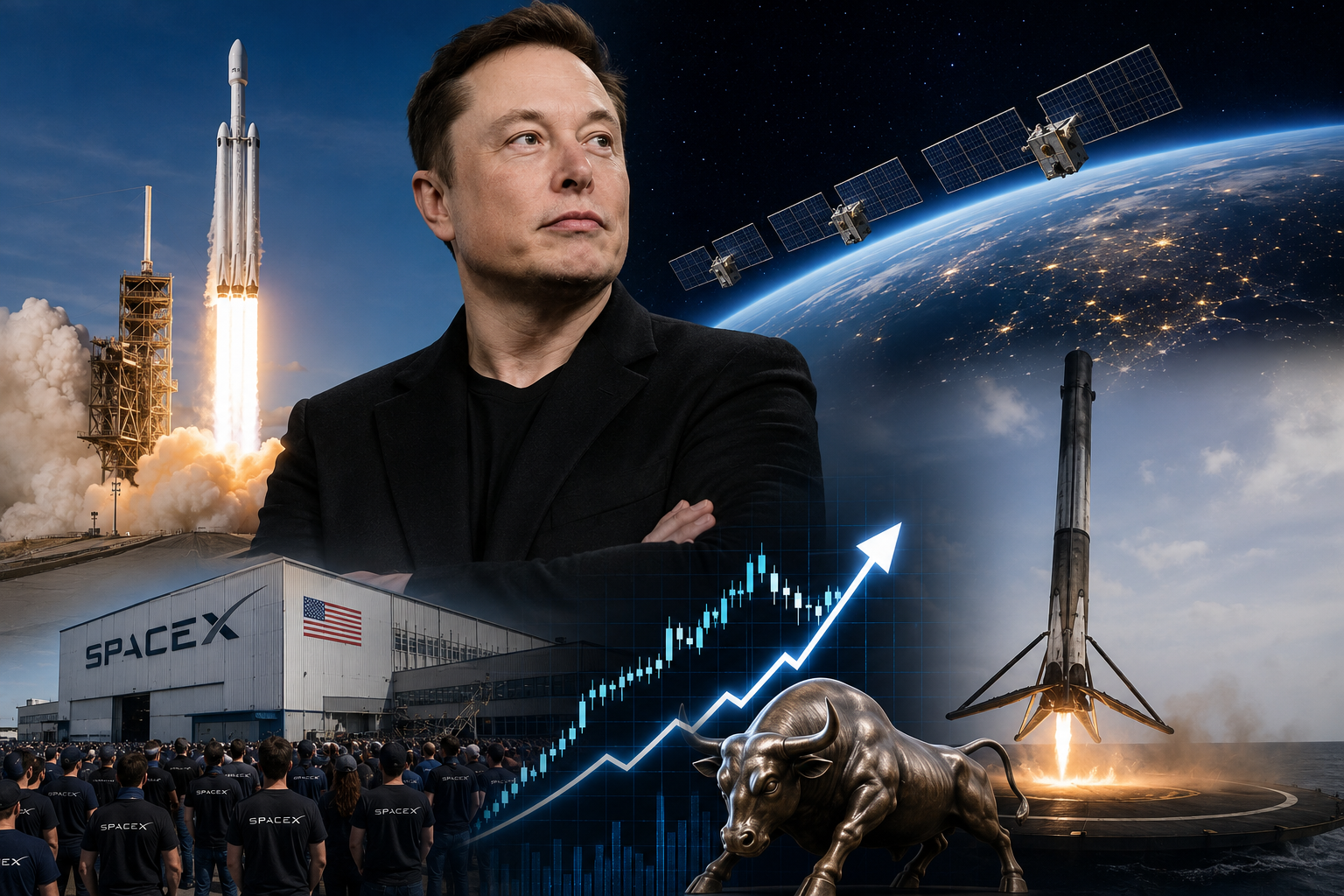
SpaceX has officially revealed plans for its long-awaited public stock offering, giving the world a rare look inside one of the most secretive and valuable private companies ever created.
The company, founded by Elon Musk, released a detailed 277-page filing explaining its finances, leadership, business operations, and long-term goals. Once the company begins trading publicly, its stock will use the ticker symbol “SPCX”.
The announcement is being seen as one of the biggest moments in financial and technology history. Analysts believe the public offering could become the largest initial public offering (IPO) ever recorded, possibly much larger than any previous stock market debut.
However, one major detail was missing from the filing: SpaceX did not reveal how much money it plans to raise from investors or the company’s expected market value. Experts say those numbers will likely be announced shortly before trading officially begins.
Despite that, the filing provided an extraordinary amount of information about a company that has mostly operated behind closed doors for years.
In its official statement, SpaceX described its mission in ambitious terms. The company said its goal is to build technologies that will make human life “multiplanetary,” help people better understand the universe, and eventually establish cities on other planets.
SpaceX plans to continue rapidly launching rockets and building more Starlink satellites, which provide internet services around the world. The company also spoke about developing advanced artificial intelligence systems powered by solar energy and eventually creating bases on the Moon and settlements on Mars.
These enormous goals come with enormous costs.
Although SpaceX is growing quickly, the company is still losing large amounts of money. Financial records showed that SpaceX earned $18.7 billion in revenue last year, an increase of 33 percent compared to the previous year. However, despite strong sales growth, the company reported a loss of $4.9 billion in 2025.
That marked a major reversal from 2024, when SpaceX had recorded a profit of $791 million. The company also lost $4.6 billion in 2023, showing that profitability has been difficult to maintain because of massive investments and expansion plans.
The losses appear likely to continue. In just the first three months of 2026, SpaceX said it had already lost $4.3 billion while bringing in $4.7 billion in revenue.
Much of the spending is tied to the expensive nature of the space industry. Building rockets, satellites, launch systems, and space infrastructure requires huge amounts of money. But another major reason for the losses is SpaceX’s growing investment in artificial intelligence.
According to the company’s filing, SpaceX spent $20.7 billion last year alone. Out of that amount, around $12.7 billion was spent on AI-related infrastructure and development. Another $4.2 billion went toward the Starlink satellite network, while $3.8 billion was used for rockets and other space projects.
Those spending levels are rising extremely quickly. In 2024, the company spent $11.2 billion, and in 2023 it spent $4.4 billion. This means SpaceX’s annual expenses have nearly doubled each year recently.
The pace has continued into 2026. During the first three months of this year alone, SpaceX spent $10.1 billion, including $7.7 billion dedicated to artificial intelligence projects.
Even with the huge losses, investors remain highly interested because of the company’s long-term vision and Musk’s reputation for achieving difficult goals.
SpaceX believes the future business opportunity ahead could be enormous. In its report, the company claimed the markets it hopes to enter could eventually be worth around $28.5 trillion in total.
The company broke this opportunity into several categories. It estimated a $370 billion market for space-enabled services and a $1.6 trillion opportunity in global internet and mobile connectivity through Starlink satellites.
The largest opportunity, according to SpaceX, comes from artificial intelligence. The company believes AI-related markets could eventually reach $26.5 trillion.
This includes ambitious plans for space-based data centres, which SpaceX says could represent a $2.4 trillion opportunity. The company also predicts major growth in AI subscriptions, digital advertising, and enterprise software applications.
Some analysts say these estimates appear extremely optimistic and reflect Musk’s well-known style of making bold predictions. However, supporters argue that Musk has repeatedly succeeded in projects once considered impossible.
SpaceX already leads the world in reusable rocket technology. The company regularly launches rockets into orbit and lands boosters back on Earth for reuse, dramatically reducing launch costs. Starlink has also become one of the world’s largest satellite internet systems.
These achievements have strengthened investor confidence and helped SpaceX become one of the most valuable private companies in the world.
Another important development came earlier this year when Musk merged SpaceX with xAI, his artificial intelligence and social media business. That merger reportedly valued the combined company at around $1.25 trillion.
If SpaceX’s public stock offering succeeds and investor demand remains strong, analysts believe Musk’s personal wealth could rise dramatically, potentially making him the first person in history with a fortune worth more than one trillion dollars.
The IPO is expected to attract enormous attention from investors, technology companies, governments, and financial markets around the world. Many experts believe it could reshape both the space industry and the future of artificial intelligence investment.
For now, investors are waiting for the final details about SpaceX’s valuation and official trading date. But even before shares begin trading, the company’s public filing has already confirmed one thing — SpaceX is no longer just a rocket company. It is trying to become one of the most ambitious technology businesses the world has ever seen.
Summary
SpaceX has officially announced plans to go public, revealing financial details that had long been kept secret. The company reported billions in revenue but also massive losses due to heavy spending on rockets, satellites, and artificial intelligence projects. Investors believe the stock offering could become the largest initial public offering in history and potentially make Elon Musk the world’s first trillionaire.
Content




×
![]()