
NASA has announced new details about its ambitious plan to build a permanent base on the Moon within the next decade. The space agency revealed several robotic landers, drones and exploration vehicles that will be used to prepare the lunar surface for future astronauts.
The project is part of NASA’s larger Moon exploration programme, which aims to establish a long-term human presence on the Moon by 2032. The United States also hopes to return astronauts to the Moon before President Donald Trump leaves office in 2028.
NASA says the Moon base will support scientific research, resource exploration and future missions to Mars. The base is planned for the Moon’s south pole, an area believed to contain frozen water that could be used for drinking water, oxygen and rocket fuel.
Several private space companies have been selected to help build the machines needed for the mission. These include Blue Origin, owned by Jeff Bezos, along with Astrobotic and Intuitive Machines.
NASA plans to first send robotic landers and hopping drones to explore the Moon’s surface before astronauts arrive. These machines will study the rocky terrain, test landing systems and carry scientific instruments.
One of the main vehicles is Blue Origin’s “Endurance” lunar lander, designed to make precise autonomous landings. Another spacecraft, Astrobotic’s Griffin-1 lander, is expected to land near Nobile Crater at the Moon’s south pole.
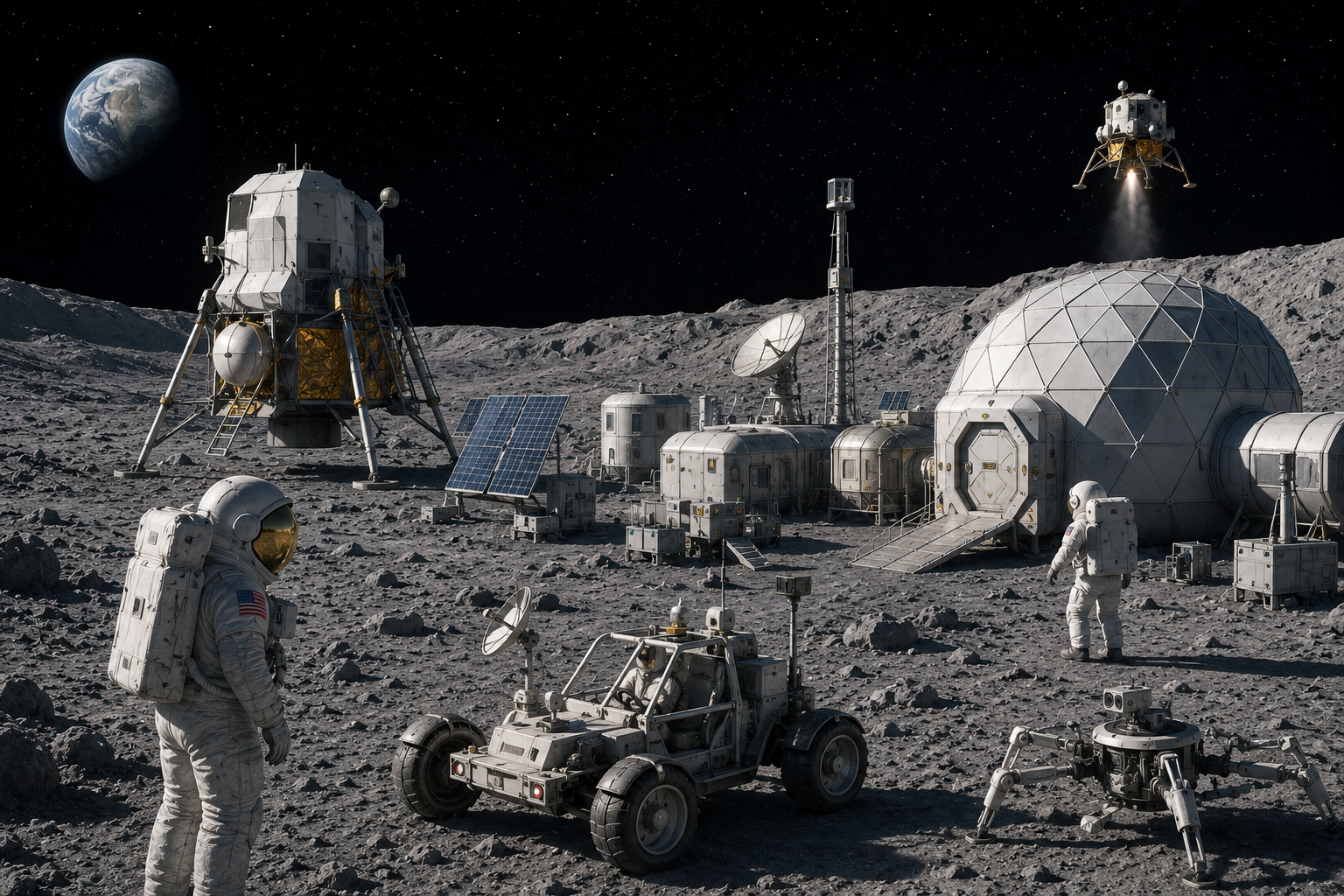
NASA also released artist illustrations showing future Moon housing, power systems and rovers that astronauts could use to travel across the lunar surface. The agency hopes to build both nuclear and solar power systems on the Moon to support long-term human activity.
According to NASA officials, the first phase of robotic exploration could continue until 2029, with around 25 launches and several tonnes of cargo delivered to the Moon.
However, many experts believe NASA’s timeline may be difficult to achieve. Scientists say the biggest challenge remains safely landing astronauts on the Moon.
SpaceX, owned by Elon Musk, is currently developing the Starship Human Landing System for NASA. But the spacecraft has faced delays and technical setbacks during testing.
At the same time, competition between the United States and China is increasing. China plans to land astronauts on the Moon before 2030 and continues expanding its space programme. Earlier this week, China launched the Shenzhou-23 spacecraft carrying astronauts to its Tiangong space station.
Some scientists believe China could reach the Moon before NASA if delays continue in the American programme.
Despite the challenges, NASA says the new Moon base project marks a major step toward long-term space exploration and future human missions deeper into the solar system.
Summary
NASA has unveiled new robotic vehicles, drones and lunar landers that will help build a permanent Moon base near the Moon’s south pole. The United States hopes the project will return astronauts to the Moon and support future missions to Mars.
Content




×
![]()