
Russian Scientists Become Among the First to Master Compressed Light Technology
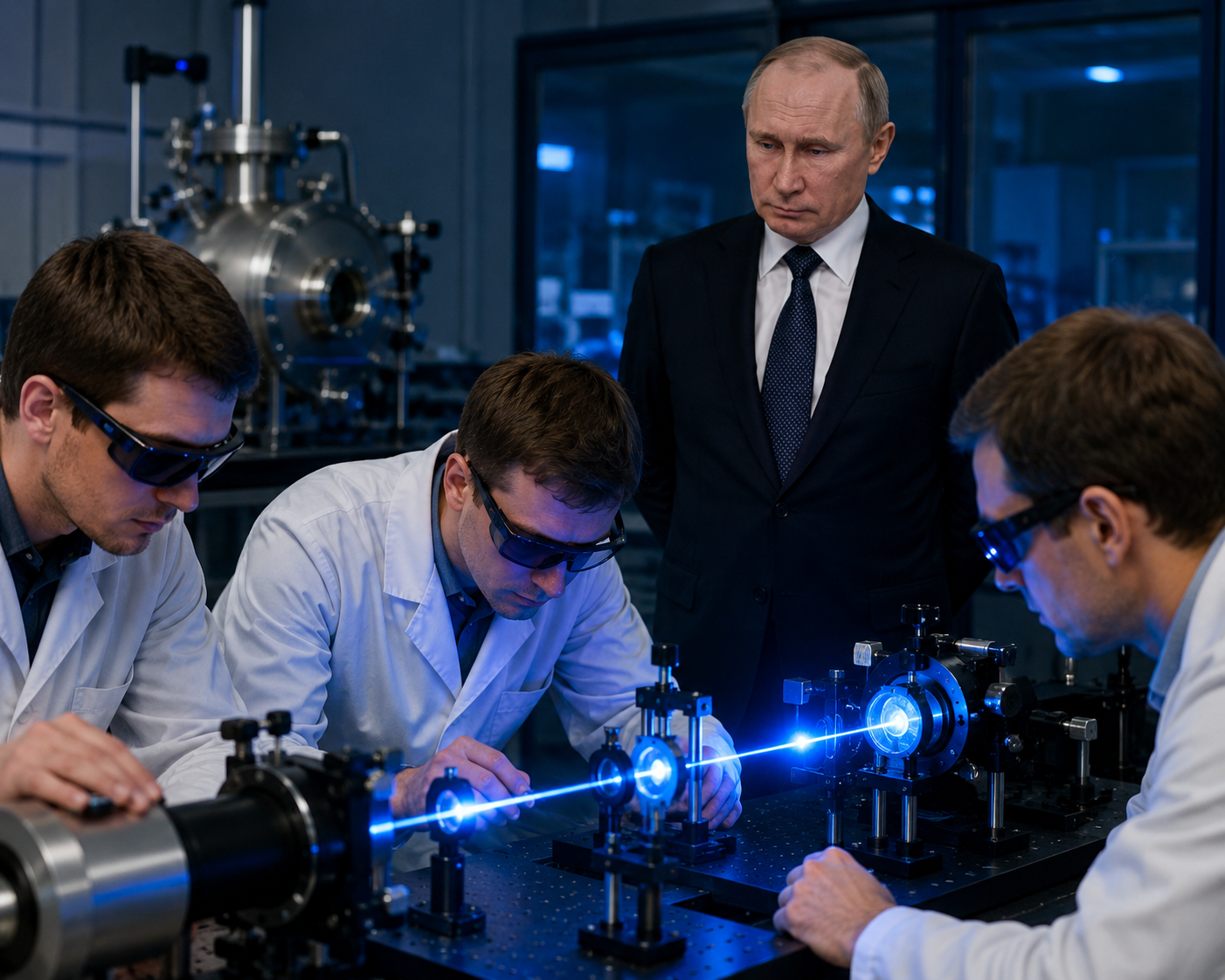
Russian scientists have announced a major scientific achievement after successfully mastering a technology known as compressed light, also called squeezed light. This technology is considered one of the most advanced areas of modern physics and could play an important role in the future of computing, communication, healthcare, and scientific research.
Compressed light is not something that can be seen with the human eye. Instead, it is a special form of light that is carefully controlled at the quantum level. Scientists use advanced lasers and optical equipment to reduce tiny natural fluctuations, or "noise," that are always present in ordinary light. By reducing this noise, measurements become much more accurate than before.
This achievement places Russian researchers among the leading teams working in quantum science. Scientists from several countries, including the United States, Germany, China, Japan, and the United Kingdom, have been studying squeezed light for many years. Russia's latest success shows that its researchers are making important progress in this highly competitive field.
What Is Compressed Light?
Normally, light contains tiny random changes in its intensity and phase. These changes are caused by the laws of quantum physics and cannot be completely removed.
Compressed light works differently. Instead of removing quantum uncertainty completely—which is impossible—it reduces uncertainty in one property while allowing it to increase in another. This makes certain measurements much more precise without breaking the laws of physics.
Scientists compare it to squeezing a balloon. When you squeeze one side of the balloon, it becomes smaller in that direction but expands in another. In the same way, compressed light reduces uncertainty in one area while increasing it somewhere else.
This special property makes compressed light extremely valuable for experiments that require very high accuracy.
Why Is This Technology Important?
Compressed light has many possible uses across different industries.
One of its biggest applications is in quantum computing. Quantum computers are expected to solve problems that today's most powerful computers cannot handle. However, they are very sensitive to noise and errors. Compressed light may help improve their stability and accuracy.
The technology can also improve quantum communication, which aims to create highly secure communication systems. These systems could allow information to be shared with a much lower risk of hacking because any attempt to intercept the signal would be detected.
Another important use is in scientific instruments that measure extremely small changes. Better precision helps scientists study atoms, molecules, and even distant objects in space.
Helping Astronomy and Space Research
Astronomers use very sensitive equipment to detect faint signals from distant stars and galaxies.
Compressed light can improve the performance of optical instruments by reducing measurement noise. This allows telescopes and detectors to observe objects more clearly and collect better scientific data.
One famous example is the use of squeezed light in gravitational wave observatories. These observatories detect tiny ripples in space-time created by massive events such as black hole collisions. Compressed light helps improve the sensitivity of these detectors, making it easier to observe signals coming from deep space.
Future space missions may also benefit from this technology as scientists continue to develop more advanced instruments.
Medical Benefits
The technology could also improve healthcare.
Medical imaging systems rely on light to examine tissues and organs inside the human body. By reducing noise, compressed light may produce clearer images while using less energy.
This could help doctors detect diseases earlier and make more accurate diagnoses.
Researchers also believe the technology could improve microscopes used in biological research, allowing scientists to study cells and tiny structures in greater detail.
Although more research is needed before these benefits become common in hospitals, experts believe the future is promising.
Better Sensors for Everyday Use
Compressed light could improve many types of sensors used in industry and science.
These sensors measure temperature, pressure, movement, magnetic fields, and other physical properties. More accurate sensors can help engineers build safer aircraft, improve navigation systems, monitor the environment, and increase manufacturing quality.
Some future smartphones, vehicles, and industrial machines may eventually benefit from technologies developed through quantum optics research.
Mastering compressed light is not something that happens quickly.
Scientists spend years designing lasers, mirrors, detectors, and optical systems that must work with incredible precision. Even tiny vibrations or temperature changes can affect experiments.
Researchers carefully test and improve their equipment many times before achieving successful results.
The latest Russian achievement reflects years of work by physicists, engineers, and laboratory specialists who collaborated to solve complex technical challenges.
Many countries are investing heavily in quantum technology because it is expected to become one of the most important scientific fields of the 21st century.
Governments and universities around the world are supporting research into quantum computing, quantum communication, advanced sensors, and precision measurement.
Russian scientists joining the group of researchers capable of mastering compressed light demonstrates the country's continued involvement in advanced physics research.
Scientific discoveries in this field often involve international cooperation, with researchers sharing ideas through academic journals and conferences.
Although the breakthrough is significant, there is still much work to do.
Many laboratory experiments must be adapted before they can be used in commercial products. Engineers will need to develop equipment that is reliable, affordable, and practical for everyday use.
Scaling up quantum technologies while maintaining their precision remains one of the biggest challenges facing researchers worldwide.
Experts believe compressed light technology will become increasingly important over the next decade.
As research continues, it could lead to faster quantum computers, more secure communication networks, better medical imaging systems, highly accurate scientific instruments, and improved industrial sensors.
The recent achievement by Russian scientists highlights the rapid progress being made in quantum science. While practical applications may still take time to reach the public, mastering compressed light is an important step toward future technologies that could transform many areas of science, industry, healthcare, and communication.
As countries continue investing in quantum research, breakthroughs like this are expected to shape the next generation of technological innovation and expand our understanding of the quantum world.
Summary
Russian scientists have achieved an important breakthrough by becoming among the first researchers to successfully master compressed light technology. This new development could improve the accuracy of scientific measurements, make quantum computers more reliable, and help create better communication systems and advanced medical devices. Experts believe the achievement could lead to major advances in science and technology over the coming years.
Content




×
![]()