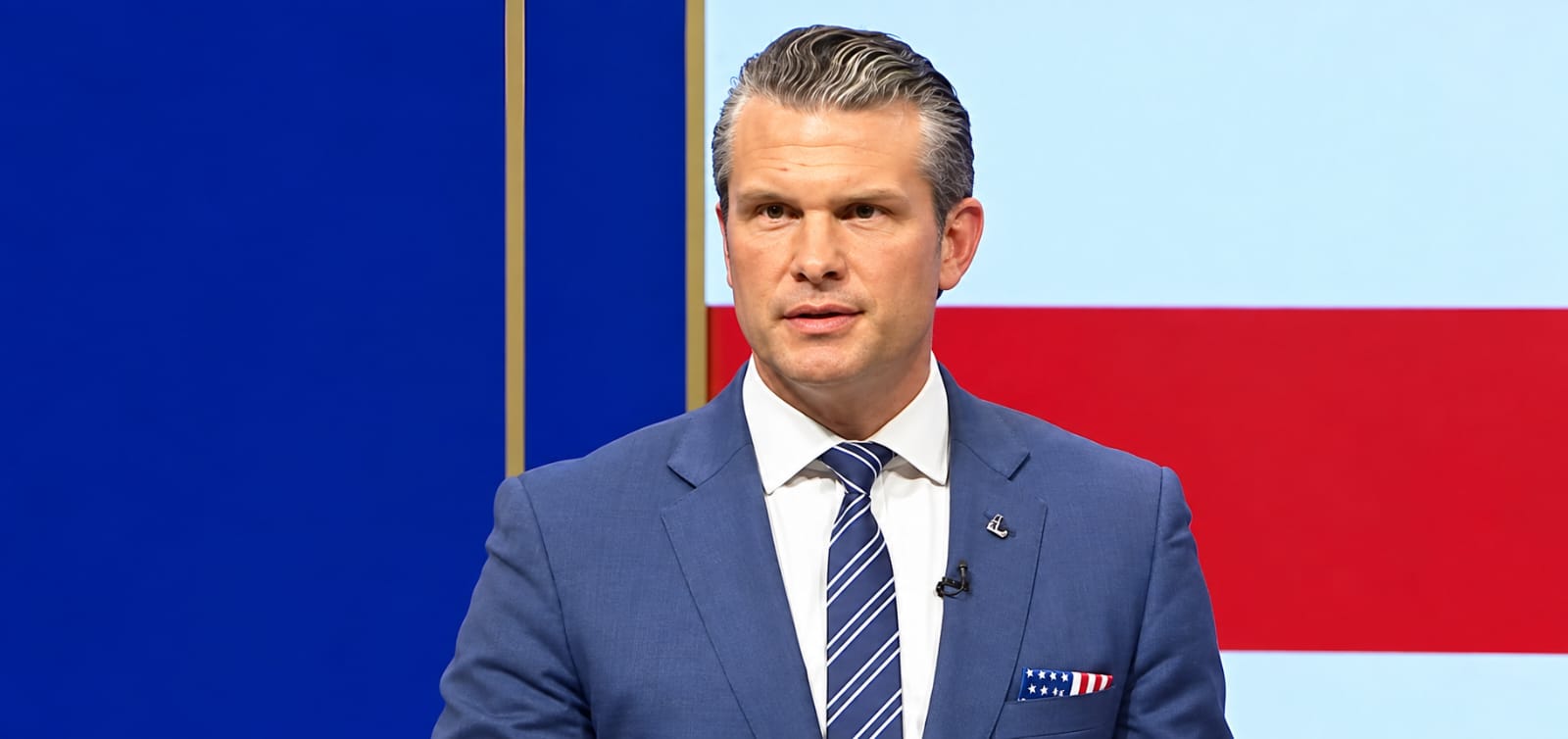
Hegseth Calls 20% Reduction 'Accountability'
Hegseth said the Pentagon would implement a 20% reduction across the board.
He rejected descriptions of the move as a “purge,” instead calling it accountability and saying the changes were long overdue.
The remarks reflect Hegseth's broader argument that the Defense Department needs to become more focused on military readiness and combat effectiveness.
Hegseth Emphasizes Military Standards
Hegseth said enforcing appearance and fitness standards should not be considered discrimination.
He argued that requiring service members to get in shape, shave or correct their uniforms represents military leadership rather than discrimination.
The secretary said the Pentagon was moving away from what he called a “woke” and “weak” department and toward a military focused on combat readiness.
He used several derogatory terms when describing groups and individuals he said did not fit his vision for the armed forces.
Hegseth Says Military Indicators Are Improving
Hegseth also claimed that several military indicators had improved under his leadership.
He said military sexual assaults and suicides were down, while Black and female recruitment had increased even after what he described as the removal of quotas.
These statements were presented by Hegseth as evidence of changes within the military. The remarks themselves did not provide supporting data or methodology for the figures.
Hegseth Attacks Media Coverage
Hegseth sharply criticized the American media during his remarks.
He said what he called the “so-called press” sometimes made Iranian state media appear reasonable.
Hegseth accused media organizations of putting American service members at risk when reporting on military issues such as ammunition stockpiles.
He acknowledged that a free press is important but argued that what he characterized as partisan activism and deliberate attacks against troops were unacceptable.
He went further, describing such activity as a “national betrayal” and using the word “treason.”
Those were Hegseth's characterizations of media criticism and reporting.
Hegseth Says Military Needs Strong Leadership
Hegseth argued that Americans are more willing to join the military when they believe they are being led by strong and patriotic leaders.
He said the goal was to build a force centered on military effectiveness rather than ideological disputes.
His comments form part of his broader effort to emphasize discipline, physical standards, military culture and combat readiness.
Hegseth Refers to Maduro
Hegseth also made a brief reference to Venezuelan President Nicolás Maduro.
He said Maduro had effectively challenged the United States to come and get him and claimed that the United States had responded.
Hegseth used the phrase “FAFO in action” to describe the situation.
He also said the administration's approach was to bring American service members home while ensuring that enemies did not return to fight again.
The comments were delivered in the context of Hegseth's broader message about military strength and deterrence.
Hegseth Says U.S. Military Is 'Unmatched'
Hegseth said the United States has the world's most powerful and prepared military.
He argued that no other country can match American military capabilities.
“Nobody can touch us. It’s not even close.”
The statement reflects Hegseth's assessment of U.S. military strength rather than an independently established ranking.
New Autonomous Warfare Command Announced
One of the major announcements was the creation of Autonomous Warfare Command.
Hegseth said the new four-star command would be responsible for scaling autonomous and robotic capabilities throughout the U.S. military.
The initiative reflects the growing importance of unmanned systems, artificial intelligence and autonomous technologies in modern warfare.
The Pentagon has increasingly focused on drones and autonomous systems as military planners prepare for conflicts in which large numbers of relatively inexpensive unmanned platforms could operate alongside traditional weapons.
Hegseth Calls for Both Quality and Quantity
Hegseth said the U.S. military had spent decades relying primarily on expensive weapons systems designed around technological quality.
He argued that future warfare would require both quality and quantity.
According to Hegseth, the military must maintain advanced capabilities while also being capable of producing and deploying large numbers of systems.
The approach places greater emphasis on mass production, autonomous platforms and potentially lower-cost military technologies.
Project Meridian Announced
Hegseth also announced Project Meridian, an initiative he said would examine the future of warfare.
He described it as an effort led by what he called some of America's best minds.
Hegseth said the project would be co-led by:
- Elon Musk
- Palmer Luckey
- Newt Gingrich
The initiative is intended to examine how warfare could evolve and what capabilities the U.S. military may need in future conflicts.
Fortress America Targets Energy Security
Another major initiative announced by Hegseth was Fortress America.
He said every major U.S. military installation would generate its own power independently of the civilian electricity grid.
The stated purpose is to ensure that military bases remain operational if an adversary successfully attacks or disrupts America's civilian power infrastructure.
Hegseth said:
“If an adversary takes down the grid, our bases stay lit.”
The proposal highlights growing U.S. concerns about cyberattacks, physical attacks and other threats to critical infrastructure.
Pentagon Plans to Harden Military Installations
Hegseth said the United States is preparing for the possibility that global supply chains could be disrupted during a major war.
He argued that military installations inside the United States need to remain operational even if international supply lines are interrupted.
The plan includes hardening installations and strengthening their ability to operate independently.
Hegseth said that in a major conflict, the United States should be able to continue fighting even if global supply networks are severely disrupted.
Hegseth Criticizes Higher Education
Hegseth also criticized the U.S. higher education system, saying he did not need to provide a lengthy explanation of what he viewed as its problems.
He pointed to the need for students to study Western civilization and the foundations of the American republic.
He said future leaders should understand what he described as the faith of Jerusalem, the philosophy of Athens, the power of Rome and the principles associated with Philadelphia and the founding of the United States in 1776.
His remarks placed greater emphasis on classical Western history and the intellectual traditions he associates with the foundations of the American republic.
A Broader Shift in U.S. Defense Policy
Hegseth's announcements combine changes to personnel policy with a broader effort to reshape how the Pentagon approaches warfare.
The proposed changes emphasize:
- Military discipline and physical standards
- Combat readiness
- Autonomous and robotic systems
- Mass production of military technology
- Domestic energy independence for military bases
- Protection against supply-chain disruption
- Research into future warfare
- Greater emphasis on Western history and American founding principles
The initiatives indicate an effort to prepare the U.S. military for conflicts involving advanced technology, autonomous weapons, contested supply chains and attacks on critical infrastructure.
Key Points
- Hegseth announced a 20% reduction and called it accountability rather than a purge.
- He emphasized physical fitness, grooming and uniform standards.
- He criticized what he described as ideological influence inside the military.
- Hegseth claimed military sexual assaults and suicides are down.
- He said Black and female recruitment has increased.
- He strongly criticized sections of the American media.
- Hegseth described the U.S. military as the world's most powerful and prepared.
- He announced the Autonomous Warfare Command, a new four-star command.
- The command will focus on scaling autonomous and robotic capabilities.
- Hegseth announced Project Meridian to study the future of warfare.
- He said Elon Musk, Palmer Luckey and Newt Gingrich would co-lead the project.
- Fortress America would make major U.S. military installations more independent from the civilian power grid.
- Hegseth said military bases need to remain operational if supply chains or the electrical grid are disrupted.
- He called for both advanced weapons and greater military production volume.
- Hegseth emphasized Western civilization and the historical foundations of the U.S. republic in discussing education and military leadership.
Source
This article is based on remarks attributed to U.S. Defense Secretary Pete Hegseth concerning Pentagon personnel policy, military readiness, autonomous warfare, infrastructure security, future military technology and education.