
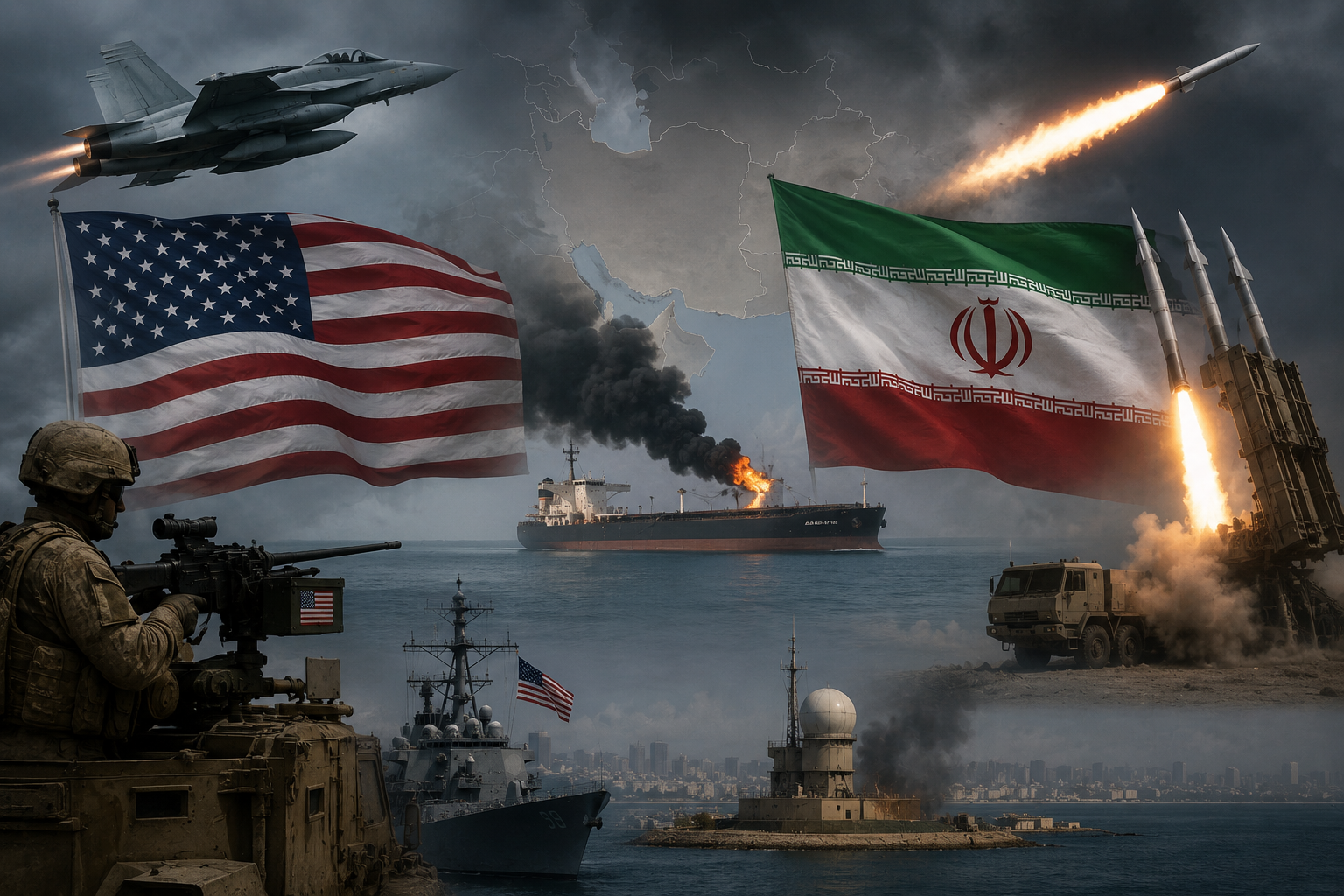
Tensions between the United States and Iran have risen sharply after both sides reported military actions in and around the strategically important Strait of Hormuz. The latest developments include US military strikes on Iran’s Qeshm Island, Iranian missile and drone launches, and security alerts in Kuwait and Bahrain.
According to the United States Central Command (CENTCOM), American forces carried out what it described as “self-defence” strikes on targets located on Iran’s Qeshm Island. The US military said the action was taken in response to threats against American forces and regional security. CENTCOM also stated that its air defence systems successfully intercepted and destroyed multiple Iranian missiles and drones launched during the confrontation.
The situation quickly spread concern across the Gulf region. Kuwait’s military announced that its air defence systems intercepted incoming missiles and drones that entered its airspace. Authorities said the projectiles were neutralized before causing damage. Meanwhile, Bahrain’s Interior Ministry activated warning sirens and urged residents to remain alert as regional tensions intensified.
Earlier reports from Iranian media indicated that explosions had been heard near Qeshm Island, a key Iranian island located close to the Strait of Hormuz. The island holds strategic importance because of its location near one of the world's busiest shipping routes for oil and gas exports.
The latest exchange of fire has added to fears that the conflict could expand beyond direct US-Iran military confrontations and affect the wider Gulf region. Several countries in the area have increased security measures as a precaution.
Iran’s Revolutionary Guard Corps (IRGC) provided its own version of events through statements reported by the semi-official Tasnim News Agency. According to the IRGC, the confrontation began when US forces allegedly targeted an Iranian oil tanker near the Strait of Hormuz. Iranian officials claimed that the strike damaged the vessel’s engine room.
The IRGC said it responded by launching naval missiles at what it described as a US-Israeli vessel operating in the region. Iranian officials then alleged that US forces struck an IRGC communications tower located south of Qeshm Island.
Following those incidents, the IRGC claimed it launched missiles and drones at American military facilities in the Gulf. Among the targets mentioned were a US airbase and the headquarters of the US Fifth Fleet in Bahrain. The IRGC also said helicopters located in a neighboring Gulf country were targeted during the operation.
However, the United States strongly rejected those claims. CENTCOM issued a statement saying reports of successful Iranian attacks on American facilities were false. The command stated that all Iranian missiles and drones aimed at US forces failed to reach their targets.
“All Iranian attacks on American forces failed,” CENTCOM said in a message posted on social media. The statement added that US forces remain fully prepared to defend themselves and regional allies against any further attacks.
The conflicting accounts highlight the growing information battle accompanying the military confrontation. While both sides acknowledge that military actions took place, they disagree on who initiated the escalation and what damage was actually inflicted.
The Strait of Hormuz remains at the center of the crisis. The narrow waterway is one of the most important energy transit routes in the world, with a significant portion of global oil exports passing through it every day. Any military activity in the area immediately raises concerns about shipping security, energy supplies, and global markets.
Security analysts warn that continued clashes around the Strait of Hormuz could have serious economic consequences. Even limited disruptions to shipping traffic could increase oil prices and create uncertainty in international markets.
Regional governments are closely monitoring the situation. Kuwait and Bahrain, both longtime US partners, have emphasized that their security forces remain on high alert. The activation of air defence systems and emergency warning measures demonstrates the seriousness with which Gulf states view the latest developments.
The confrontation also comes at a sensitive diplomatic moment. Recent efforts aimed at reducing tensions between Washington and Tehran have struggled to make progress. Military exchanges such as these risk undermining any remaining hopes for a negotiated settlement.
Observers note that neither side appears eager for a full-scale regional war, but the danger of miscalculation remains high. With military assets from multiple countries operating in close proximity, even a limited incident could trigger a wider escalation.
As the situation continues to develop, governments, shipping companies, and international organizations are watching events closely. Additional military actions or retaliatory strikes could further increase instability across the Middle East.
For now, both the United States and Iran are standing by their respective accounts, while Gulf nations remain on alert amid fears that the conflict could spread beyond its current boundaries. The coming days may prove critical in determining whether the latest confrontation remains contained or develops into a broader regional crisis.
Summary
The US says it carried out self-defence strikes on Iran’s Qeshm Island and intercepted multiple Iranian missiles and drones. Kuwait and Bahrain activated air defences after incoming threats were detected. Iran’s IRGC claims the clashes began after a US strike on an Iranian oil tanker and says it responded by targeting US military sites. The US denies Iran’s claims of successful strikes, saying all attacks on American forces failed. The situation has increased tensions across the Gulf region and raised concerns about security near the Strait of Hormuz.
Content


×
![]()