
The Russia-Ukraine war began on 24 February 2022, when Russia launched a full-scale invasion of Ukraine. Russian forces attacked from several directions, including from Russia, Belarus, and Crimea. At the beginning of the war, Russia quickly captured many towns and cities, raising fears that the Ukrainian capital, Kyiv, could also fall.
However, Ukraine's military strongly resisted the invasion. Within weeks, Ukrainian forces pushed Russian troops away from Kyiv, Chernihiv, and Sumy. Later in 2022, Ukraine launched successful counteroffensives in the Kharkiv and Kherson regions, reclaiming thousands of square kilometres of land. These victories showed that Ukraine could take back occupied territory despite Russia's larger military.
As the war continued, fighting became slower and focused mainly on eastern and southern Ukraine. Russia concentrated its efforts on the Donbas region, which includes the Donetsk and Luhansk regions, while also strengthening its control over parts of Zaporizhzhia and Kherson.
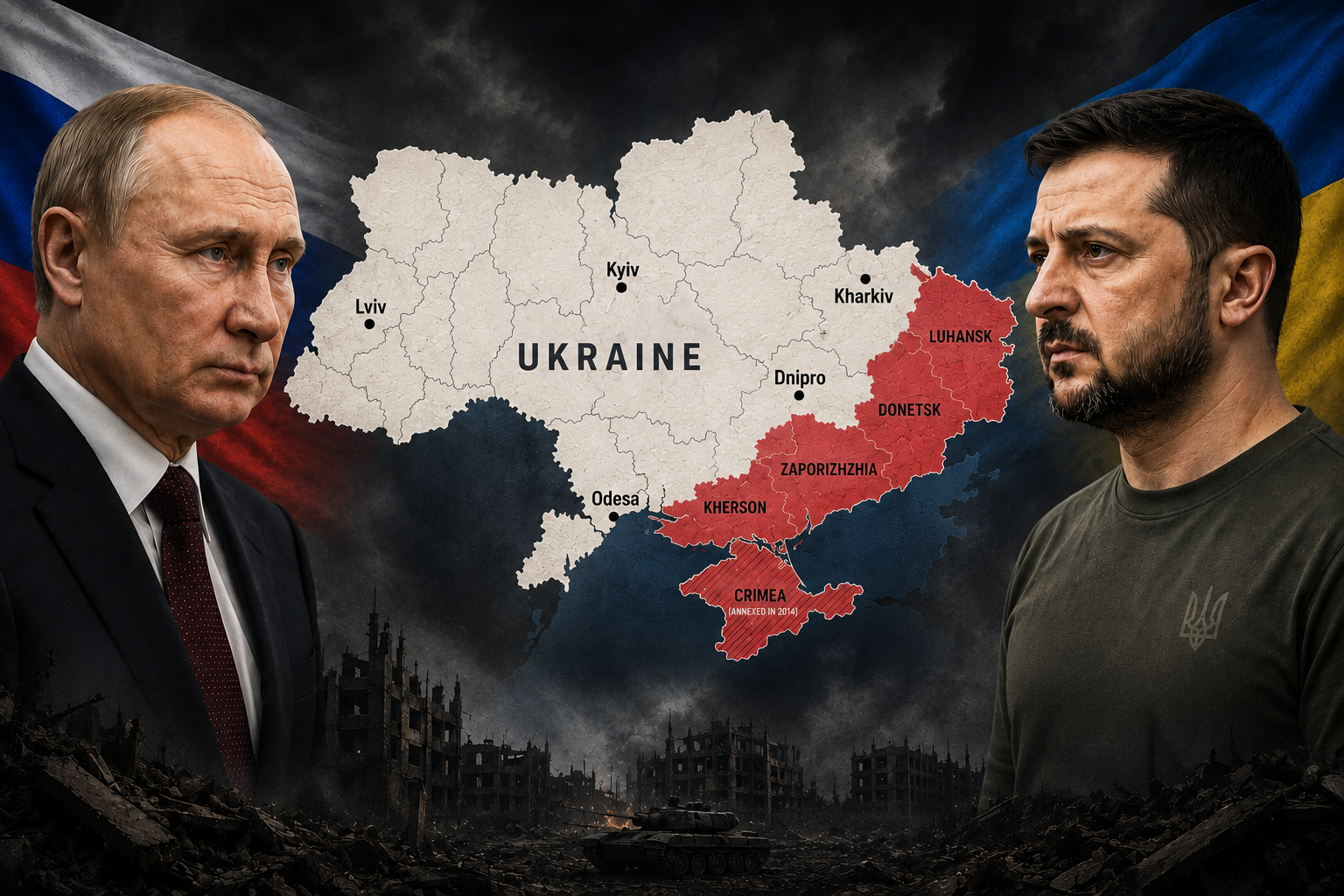
According to recent estimates, Russia now controls around 18% to 20% of Ukraine's internationally recognized territory, which equals roughly 110,000 square kilometres. This includes Crimea, which Russia seized in 2014, along with most of the Luhansk region and large parts of Donetsk, Zaporizhzhia, and Kherson.
Russia's occupied territory includes:
Crimea – under Russian control since 2014.
Nearly all of Luhansk region.
Most of Donetsk region, although fighting continues.
Large parts of Zaporizhzhia region.
Parts of Kherson region, mainly on the eastern side of the Dnipro River.
At the highest point of the invasion in early 2022, Russia briefly controlled about 27% of Ukraine's territory. However, Ukraine later regained large areas during its counteroffensives. Today, Russia controls less land than it did during those first months, but still occupies a significant part of Ukraine.
The frontline now stretches for more than 1,000 kilometres, making it one of the longest active battle lines in the world. Much of the fighting takes place around towns and villages in eastern Ukraine, where both sides use drones, artillery, missiles, and trenches. Small territorial changes happen regularly, but major breakthroughs have become much less common.
Russia has continued trying to advance in eastern Ukraine during 2026. It has claimed control over several towns, but some of these claims have been disputed by Ukraine. In several cases, Ukraine has said fighting is still ongoing and that Russian claims cannot be independently confirmed.
Although Russia controls about one-fifth of Ukraine, Ukraine has also carried out attacks inside Russian territory using drones and long-range weapons. Ukrainian forces have targeted military bases, oil facilities, and logistics centres far inside Russia. These strikes are intended to weaken Russia's ability to continue the war.
Despite more than four years of fighting, neither side has achieved a complete military victory. Russia continues to hold a large amount of Ukrainian territory, while Ukraine remains determined to recover its occupied land. Peace talks have so far failed to produce a lasting agreement, and heavy fighting continues along much of the frontline.
The war has caused enormous destruction. Millions of people have been displaced, thousands of civilians have been killed or injured, and many cities and villages have been damaged or destroyed. The conflict has also affected global food supplies, energy prices, and international security.
As of July 2026, the overall picture is that Russia occupies approximately 18–20% of Ukraine's territory, while Ukraine continues to defend the remaining 80–82% and works to regain occupied areas. The situation remains active, with control of some frontline locations changing as battles continue.
Summary
Since the full-scale war began in February 2022, Russia has taken control of large parts of eastern and southern Ukraine. As of July 2026, Russia controls about 18–20% of Ukraine's internationally recognized territory, including Crimea, which it annexed in 2014. Although Russia made rapid gains at the start of the war, Ukraine later recaptured many areas. Fighting continues, and the front line still changes in some places.
Content
×
![]()