
The United States is facing a difficult military challenge as the war involving Iran continues into its sixth month. Washington has moved some military equipment and forces from Asia toward the Middle East, where more resources are needed. The moves have raised concerns among US allies in Asia, particularly Japan, South Korea, Taiwan and the Philippines.
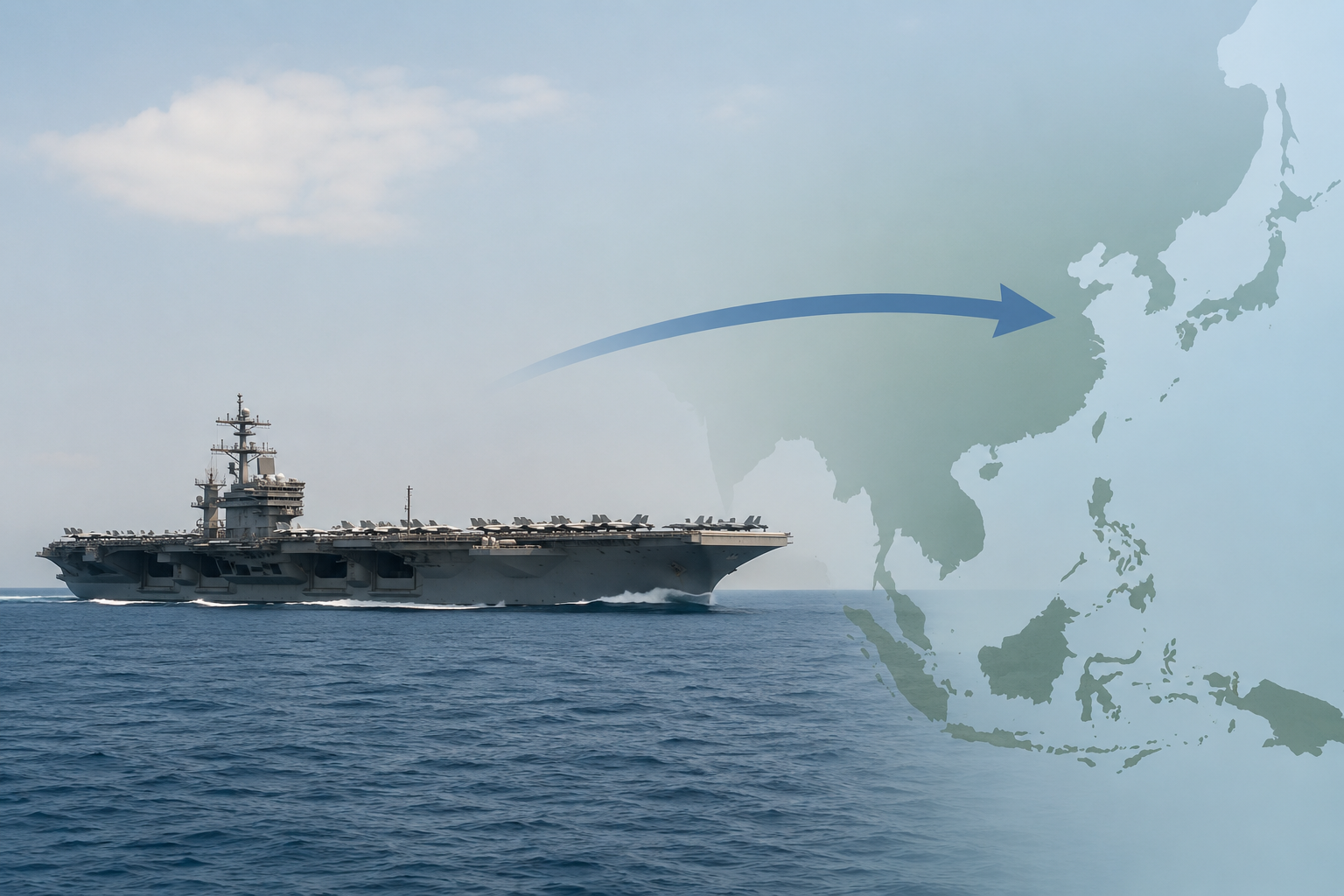
One of the most important developments was the decision to move the USS George Washington, the last US aircraft carrier based in Asia, from Japan toward the Middle East. The carrier is being sent to help relieve the USS Abraham Lincoln, which has already spent around nine months deployed in the region.
Reports about conditions on the USS Abraham Lincoln have also raised concerns. Some reports said the ship faced food shortages and problems with toilets and showers. These conditions reportedly created health and sanitation problems for sailors.
The movement of the George Washington is important because US aircraft carriers are a major part of America's military presence and ability to respond to crises. With the carrier temporarily leaving Asia, some experts believe America's ability to quickly react to a serious situation in the region could be reduced.
William Yang, a senior analyst focusing on Northeast Asia, said the carrier's movement is part of a wider trend that could affect US efforts to deter China. In simple terms, deterrence means having enough military power to convince another country that attacking or taking aggressive action would be too risky.
China has been increasing its own military activity in the Western Pacific. Chinese aircraft carriers, including the Liaoning and Shandong, have increasingly operated beyond the First Island Chain. This area stretches from Japan through Taiwan and the northern Philippines toward Borneo.
Chinese coastguard activity has also increased near waters east of Taiwan. These waters are important to Taiwan, Japan and the Philippines. Experts say China's activities could be designed not only to pressure Taiwan but also to see how Japan, the Philippines and the United States respond.
This is one of the reasons US allies are watching America's military movements closely. They worry that if the United States becomes temporarily less active in Asia, China could become more confident and increase pressure on its neighbors.
However, experts say the situation should not be exaggerated. Although the George Washington is leaving the region, a large number of American military and civilian personnel remain across the Asia-Pacific. About 375,000 US military and civilian personnel are assigned to the US Pacific Command, with tens of thousands stationed in Japan and South Korea.
Other important US military capabilities also remain in the region. For example, Amphibious Ready Groups, which can operate with advanced aircraft including F-35B fighter jets, are still present. This means the United States has not completely removed its military power from Asia.
The move also fits into President Donald Trump's broader approach to US alliances. His administration has pushed allies to spend more money on their own defence instead of depending heavily on the United States.
The US 2026 National Defense Strategy calls for greater burden-sharing among allies and partners. It also encourages European and Asian allies to increase defence spending.
Countries in Asia are already responding. Japan, South Korea and Taiwan have increased or planned to increase their defence spending. Taiwan recently announced plans to increase its defence budget significantly in 2027. The Philippines has also discussed increasing defence spending as it faces growing tensions with China.
Experts believe this trend could continue. Asian countries may increasingly work together and develop their own military capabilities while still relying on the United States for support.
At the same time, some security experts do not believe the US is permanently turning away from Asia. They argue that the movement of the aircraft carrier is mainly a short-term response to the war in the Middle East.
Kei Koga, an expert on East Asian security, said the move is concerning in the short term but does not necessarily mean that the United States is making a long-term strategic withdrawal from Asia.
Another expert, K Tristan Tang, said China remains extremely important to Trump's broader strategy. Even while Washington is focused heavily on Iran, US economic and strategic competition with China is likely to remain a major priority.
Overall, the movement of US military assets from Asia to the Middle East has created uncertainty among America's Asian allies. The main concern is that China could use the temporary reduction in US military presence to increase pressure in the region. However, the United States still has a large military presence across Asia, and experts do not currently see the carrier's deployment as proof that Washington is abandoning the region.
Summary
The United States is moving some important military assets from Asia to the Middle East as the war involving Iran continues. This has made US allies such as Japan, South Korea, Taiwan and the Philippines concerned about whether Washington can still respond quickly to possible threats from China. The biggest recent move was the deployment of the USS George Washington aircraft carrier from Japan toward the Middle East. Experts say the move could temporarily reduce US military flexibility in Asia and may give China more confidence to test the region. However, they also say most US forces remain in Asia, meaning the move does not necessarily show that America is leaving the region.
Content

×
![]()