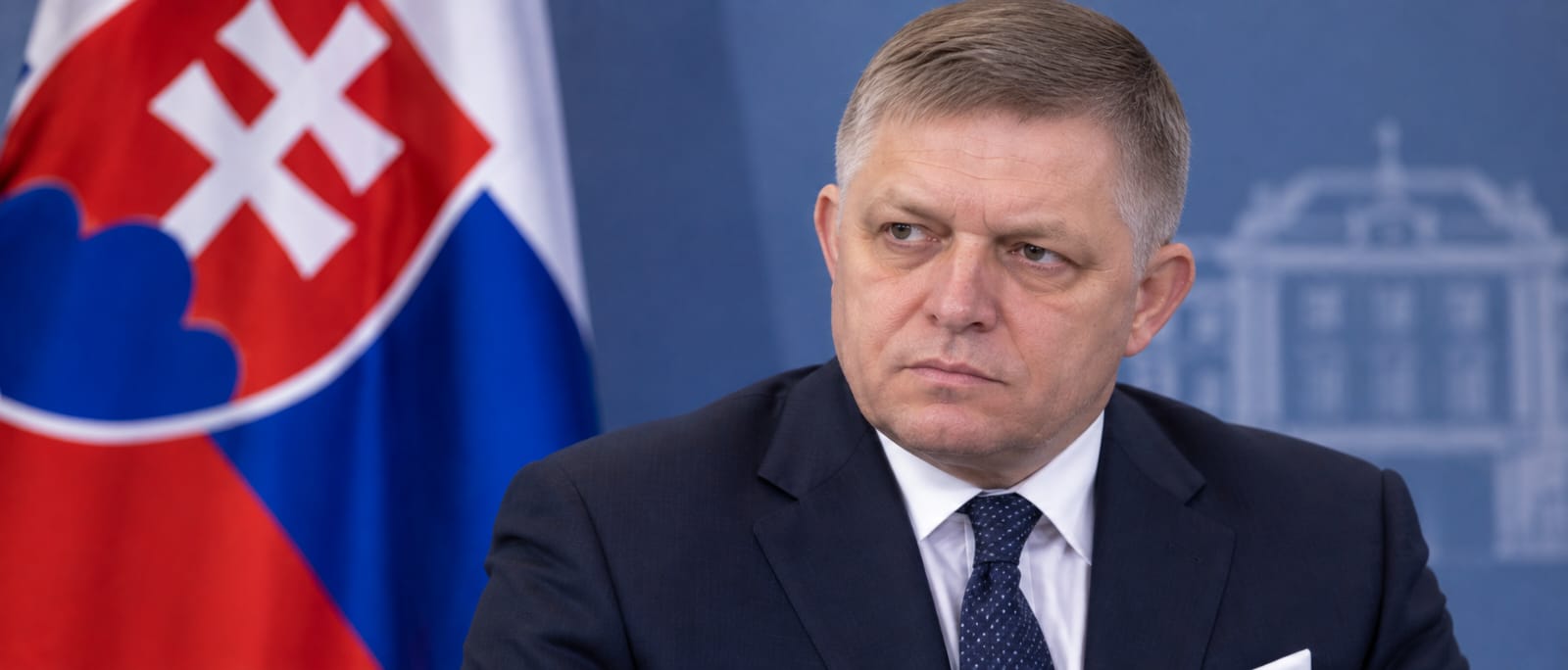
Fico Opposes Slovakia Being Drawn Into a War
Fico said he does not want a military confrontation between NATO and Russia.
He said his government would do everything possible to ensure that Slovakia is not drawn into what he described as an “irresponsible military adventure.”
Under his government, Fico said, Slovak soldiers would not be sent outside Slovakia under what he called a fabricated pretext to fight Russia or another country.
Fico has repeatedly expressed opposition to Slovakia becoming directly involved in the Russia-Ukraine war and has questioned policies that he believes could increase the risk of a wider European conflict.
Fico Questions How NATO Article 5 Would Work
Fico also discussed NATO's Article 5, which establishes the principle of collective defense among NATO members.
He argued that even if a genuine armed attack occurred against one or more NATO countries, the treaty provides different possible forms of assistance rather than automatically requiring every member to send combat troops.
His comments came after he publicly questioned whether Slovakia should be expected to send thousands of soldiers if Article 5 were invoked.
The issue has become particularly significant as NATO members consider how the alliance would respond to a possible attack on a member state amid heightened tensions with Russia.
NATO Article 5 Provides for Collective Assistance
Article 5 states that an armed attack against one or more NATO members is considered an attack against all.
However, each member determines what action it considers necessary. NATO's treaty does not specify that every member must respond by sending ground troops.
Fico's description of the range of possible assistance therefore focuses on an important feature of the treaty: collective defense does not prescribe a single military response for every member.
Fico Raises Ukraine's Reported Military Losses
Fico also referred to comments by Polish Prime Minister Donald Tusk concerning Ukrainian military casualties.
According to reports, Tusk said Ukrainian partners had told him that Ukraine was recently losing around 27,000 military personnel killed and wounded each month.
Fico said he had no right to question the figure, but suggested that deliberately exaggerating casualty numbers could potentially encourage Western countries to provide greater military and financial assistance to Ukraine.
He described the reported number as extremely high.
The figure has not been independently established in the material available publicly. Tusk attributed it to information from Ukrainian partners, while Ukraine's military casualty figures remain sensitive and are not fully disclosed.
Fico Links Current Events to Munich in 1938
Fico also referred to the Munich Agreement of 1938, when Britain, France, Italy and Nazi Germany agreed to the transfer of Czechoslovakia's Sudetenland to Germany.
Fico said Slovaks have their own historical experience of Munich and described the agreement as a betrayal by democratic powers that were bound to Czechoslovakia by treaty.
He compared the experience to being “thrown to Hitler like a roasted chicken,” using the historical episode to emphasize his concerns about relying on external powers for security.
Historical Memory Shapes Fico's Position
The Munich Agreement remains an important part of political and historical debate in Central Europe.
Fico's reference connects that history with his current argument that Slovakia should retain control over decisions involving its military and avoid being drawn into conflicts involving larger powers.
His comments also reflect his broader emphasis on Slovakia's national interests and his opposition to policies that he believes could lead to direct confrontation with Russia.
Slovakia's Position on the Ukraine War
Slovakia remains a NATO and European Union member, while Fico's government has taken positions that differ from those of several other European governments on military support for Ukraine.
His latest remarks emphasize avoiding direct Slovak military involvement while also questioning how collective-defense commitments should operate in a potential NATO-Russia confrontation.
The comments come as European countries continue to debate military support for Ukraine and measures intended to deter further Russian attacks.
Key Points
- Fico said he does not want a NATO-Russia military conflict.
- He said Slovakia should not be dragged into a wider war.
- He said his government would not send Slovak soldiers abroad to fight Russia under what he considers fabricated pretexts.
- Fico questioned how NATO's Article 5 would apply in a potential conflict.
- Article 5 requires collective assistance but does not prescribe one specific form of response.
- Fico cited a reported Ukrainian monthly casualty figure of about 27,000 killed and wounded.
- The figure was attributed by Tusk to information from Ukrainian partners and has not been independently established.
- Fico compared Slovakia's historical experience with the 1938 Munich Agreement to his concerns about current European security policy.
Source
This article is based on remarks attributed to Slovak Prime Minister Robert Fico concerning NATO, Russia, Ukraine and Slovakia's security policy.